Stop losing a Saturday every quarter to IFTA paperwork.
A mile logged in the wrong state. A fuel stop that never made it into the pile of receipts. A rate table nobody updated. That's how an honest mistake turns into a letter you didn't want.
CabPurser pulls tax rates straight from IFTA's own source, helps you catch the jurisdiction before you have to, and keeps receipts from piling up unrecorded — no 3-year contract, no fleet-telematics pricing built for someone else's truck count.
- Solo owner-operators
- 2–3 truck family outfits
- Small dispatch offices
- Independent contractors
The estimator works today, in your browser, with no signup — it is the calculation engine with a form on it. No card, no contract, no sales call.
The next IFTA return is for 3Q2026
July 1 through September 30, 2026. Every mile and every gallon inside those dates belongs on it.
Monday, November 2, 2026
Filing deadline for 3Q2026. October 31 falls on a Saturday this year, so the due date moves to the next business day.
Weekend shifting only. CabPurser does not shift a deadline for a federal or state holiday — holiday calendars differ by year and by jurisdiction, and encoding the wrong one would be worse than saying nothing. Confirm the date with your own base jurisdiction before you rely on it.
What you can use today, free and without an account
Four pages, open to anyone, no signup and no card. Nothing here is a preview or a demo — click it and it runs. They exist because the answers were already sitting in the code, and a reference nobody can check is not worth much.
-
Estimate a quarter
The calculation engine with a form on it. Fleet MPG, taxable gallons per jurisdiction, surcharges, a total. Runs entirely in your browser.
-
This quarter's rate table
All 58 jurisdictions and four fuel types for 3Q2026, read from IFTA's own matrix — the same data the calculator uses.
-
Filing deadlines to 2028
Every due date with the weekend roll-forward applied, plus what the deadline actually obliges you to do.
-
Do you have to file at all?
The qualified-vehicle test, what fuel must be reported, and the records you have to keep for four years — quoted from IFTA's own documents.
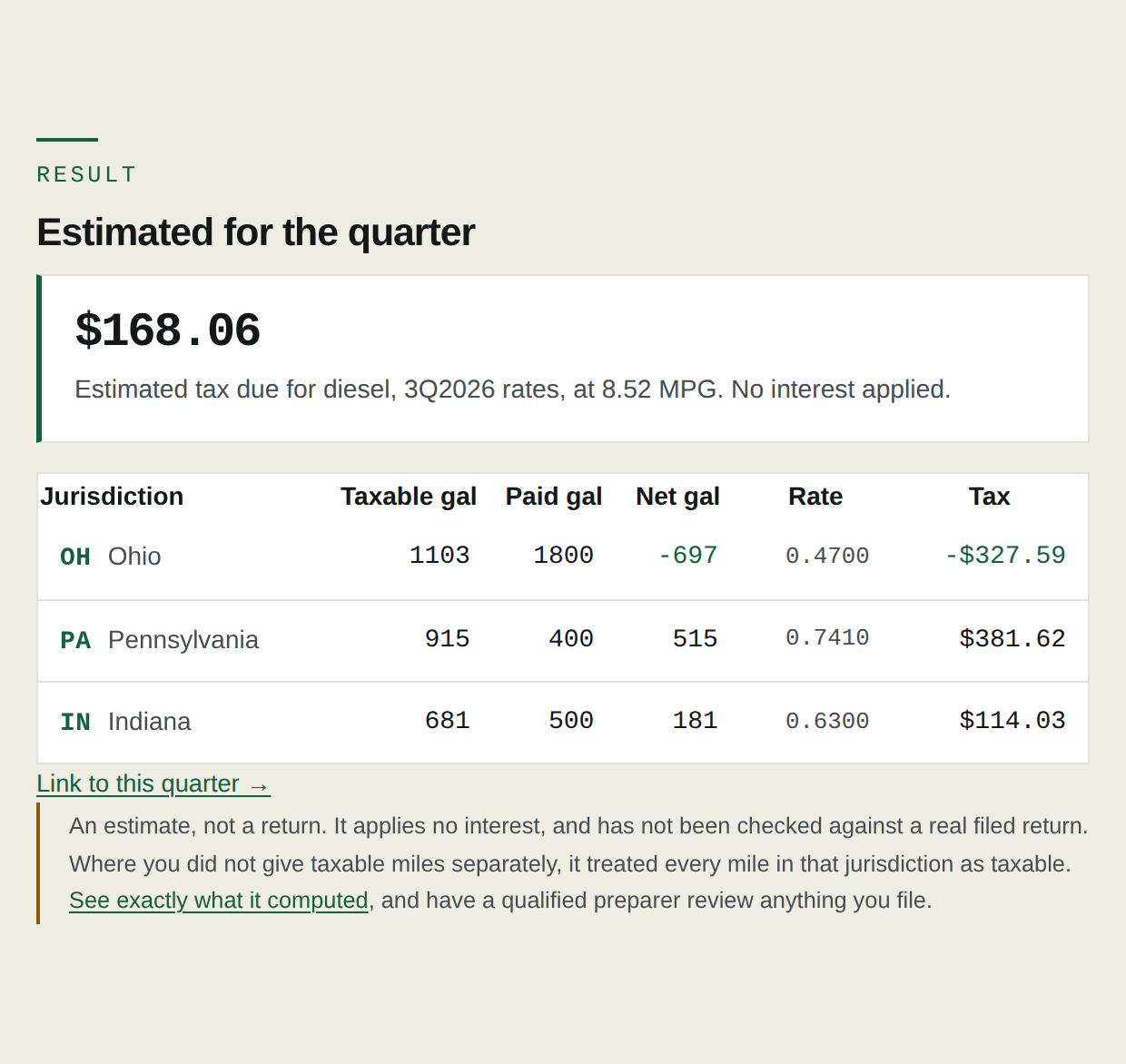
A real run, not a mock-up: 23,000 miles and 2,700 gallons of diesel across Ohio, Pennsylvania and Indiana at 3Q2026 rates. Ohio comes back a credit because that is where the fuel was bought. Nothing was uploaded to produce it — the arithmetic ran in the browser. Open this exact quarter and put your own numbers over it.
What a quarter actually costs a small carrier
None of this is hypothetical — it's the well-documented way IFTA filing goes wrong for exactly the size of operation CabPurser is built for.
spent per truck, every quarter, manually compiling mileage and fuel data into a filing — a chunk of a slow week, four times a year
whichever is greater — the penalty your base jurisdiction may assess for a late return, a return never filed, or taxes underpaid. The percentage side has no ceiling, and underpaying is as much a trigger as filing late
typical annual cost of an accountant or filing service — and you still have to hand them clean mileage and fuel data yourself
The penalty is the actual rule, not an estimate: IFTA Articles of Agreement R1220.100 (rev. 2026-03-11) — "a penalty of $50.00 or 10 percent of delinquent taxes, whichever is greater, for failing to file a tax return, filing a late tax return, underpaying taxes due." Your base jurisdiction may add penalties of its own on top of it (R1220.300). The hours and the accountant cost above are industry-reported figures, directional only, and not a primary citation.
These are industry averages describing the problem, not a projection of your result. CabPurser does not promise time savings, cost savings, penalty avoidance, or a compliant filing, and using it does not replace a qualified tax preparer's review of your return.
What CabPurser will do for you, and where each part stops
This is the product, not the free pages above it. The code is written and under test, nobody is filing with it yet, and there is no signup to join. One piece of it — the calculation — you can already run for free above; the rest opens when it opens. Each part below prints the bit of itself that doesn't work, because that is the bit you would otherwise meet a week before a deadline.
Rates straight from IFTA's own source
Per-jurisdiction fuel-tax math using rates pulled from IFTA Inc.'s own tax matrix — all 58 jurisdictions, four fuel types, not a spreadsheet somebody forgot to update this quarter. Read this quarter's whole table — it's the same data the calculator uses.
Rates are current only as of the quarter shown with them, and 58 jurisdictions set their own rates, surcharges and rules every quarter. Check every rate against that jurisdiction's own published matrix before you file.
The one part you can already run
The same engine, with a form on it, at /estimate/ — this quarter's rates, fleet MPG, per-jurisdiction taxable gallons, surcharges and a total. It runs entirely in your browser; nothing is uploaded.
An estimate, not a return. It applies no interest, and like everything else here it has not been checked against a real filed return.
Snap a receipt, don't lose it
Photograph a fuel receipt at the pump. CabPurser pulls the numbers and lines up the jurisdiction — you get a quick look before anything's counted.
Automated reading of a receipt can misread a figure. Every extracted number has to be confirmed by you before it counts toward a return; that check is part of the product, not an optional step.
Miles split the way the return wants them
Log a run once and break it into the states and provinces it actually crossed. A jurisdiction that isn't an IFTA member gets refused with the reason, rather than quietly accepted and carried into a return.
Basic load tracking
Track units and loads by status — scheduled, in transit, delivered — without a full dispatch-board system you don't need at this fleet size.
Runs from your phone
No separate desktop dashboard to log into. Handle a fuel stop or check a load status from the truck, the same way you already run everything else.
How the math works, in plain terms
This is the part most fuel-tax tools won't show you. If a number is going on your return, you should be able to see where it came from.
-
Rate source
IFTA Inc.'s own tax matrix, read for the current quarter (3Q2026) — not the static download archive, which lags a quarter behind. The full table is published here.
-
Coverage
58 jurisdictions — 48 US states and 10 Canadian provinces — priced for gasoline, diesel, gasohol and propane.
-
Surcharges
Indiana, Kentucky and Virginia charge a surcharge on top of the base rate. It's computed on taxable gallons, never on net taxable gallons, so it can only ever add to what you owe — the rule Florida's own Form 85800 states outright, and the one that is easy to get backwards.
-
Missing rates
A jurisdiction and fuel type with no resolvable rate is excluded with a stated reason, never silently taxed at zero. When that happens the return is marked incomplete and no total is produced at all — a clean-looking number that quietly omits real liability is worse than no number.
-
A live example
Indiana ran a gasoline tax holiday at $0.00/gal through September 5, 2026, reverting to $0.3700 on September 6. Without a purchase date CabPurser excludes that pair rather than guessing which side of the boundary a gallon fell on; with one it prices each side at the rate then in force.
-
Who does the arithmetic
Deterministic code, every time. The vision model reads a receipt and nothing else — it never computes a dollar amount, and what it reads has to be confirmed by you before it counts.
-
Under test
Over 1,400 automated tests, with every calculation fixture citing the official document it came from. One real surcharge bug has already been caught this way and fixed.
Tests passing is not the same as verified against a real filing. See below for exactly where that line sits.
Where the verification actually stops
CabPurser's per-jurisdiction arithmetic is checked against official worked examples published by state agencies. A complete multi-jurisdiction return, though, has not been verified against a real filed return — no government publishes a full worked example to check one against, and seven-plus official sources were checked looking for one.
Treat every figure as a draft for a qualified tax preparer to review, not a finished filing. That gap closes when a real quarter runs through the system alongside a real return, and not before.
What people ask first
Is it available now?
No. The calculation engine, receipt capture and load tracking are built and under test, but nobody is filing with it yet. The next step is a real quarter run in parallel with a real return by a real carrier.
What does it cost?
Not set yet, and we won't invent a number to fill a page. For context, the closest existing tools for this fleet size sit around $19–20 a month. Whatever CabPurser charges will be priced for a one-truck operation, not scaled down from a contract built for someone else's fleet size.
Is this an ELD?
No. CabPurser does not do hours-of-service logging and is not a registered ELD. It covers fuel tax, receipts and basic load tracking. Keep whatever ELD you already run.
Does it file the return for me?
No. It produces the figures and an export you can hand to your preparer or type into your base jurisdiction's own filing system. You file, you review, and you stay responsible for what's on the return.
Which jurisdictions are covered?
All 58 IFTA member jurisdictions — the 48 contiguous US states plus 10 Canadian provinces. Alaska, Hawaii and the District of Columbia are not IFTA members, so entering one is refused with that reason rather than accepted. Every rate for this quarter is published here.
What happens when rates change next quarter?
The rate table is re-read from IFTA's matrix and the snapshot records the quarter, the source URL and the time it was retrieved. A test fails on purpose the moment the calendar rolls past the quarter the current rates came from, so a stale table can't sit there unnoticed.
Who is behind it?
CabPurser a registered Ohio trade name of JSON Holdings LLC. It's built by people who would rather tell you where the verification stops than pretend it doesn't.
Tell us where to send the invite
If you run 1–10 trucks and file IFTA yourself, you're exactly who this is being built for — and running a real quarter alongside your real return is the most useful thing anyone can do for it right now.
Goes to a person, not a drip sequence. The ask is one quarter you have already filed — here is exactly what that means.